On this page
- Why people buy them: the vegetable gap is real
- What's actually in a greens powder
- What the research on greens powders actually shows
- Proprietary blends: the transparency problem
- Contamination: microbes and heavy metals
- Cost: greens powder vs. frozen vegetables
- Who might benefit, and who should be careful
- How to choose a quality greens powder
- The bottom line
Key takeaways
- Eating vegetables is strongly linked with lower cardiovascular and all-cause mortality. Greens powders have no comparable outcome evidence.
- The best-supported effect of fruit and vegetable concentrates is modest: they raise blood levels of some vitamins. Recent product trials have been small, short or company-linked.
- Proprietary blends only disclose a total weight, so you usually can't tell how much of each green, alga or probiotic you're getting.
- Contamination is a real issue. A 2025-2026 Salmonella outbreak tied to moringa leaf powder sickened 131 people, and most of those interviewed reported a super greens powder. Choose products tested for microbes and heavy metals.
- Frozen broccoli, kale and spinach averaged about $0.92 to $1.19 per cup-equivalent in 2023 (USDA data). Compare that with a powder's price per scoop, and remember that only the vegetables come with outcome evidence.
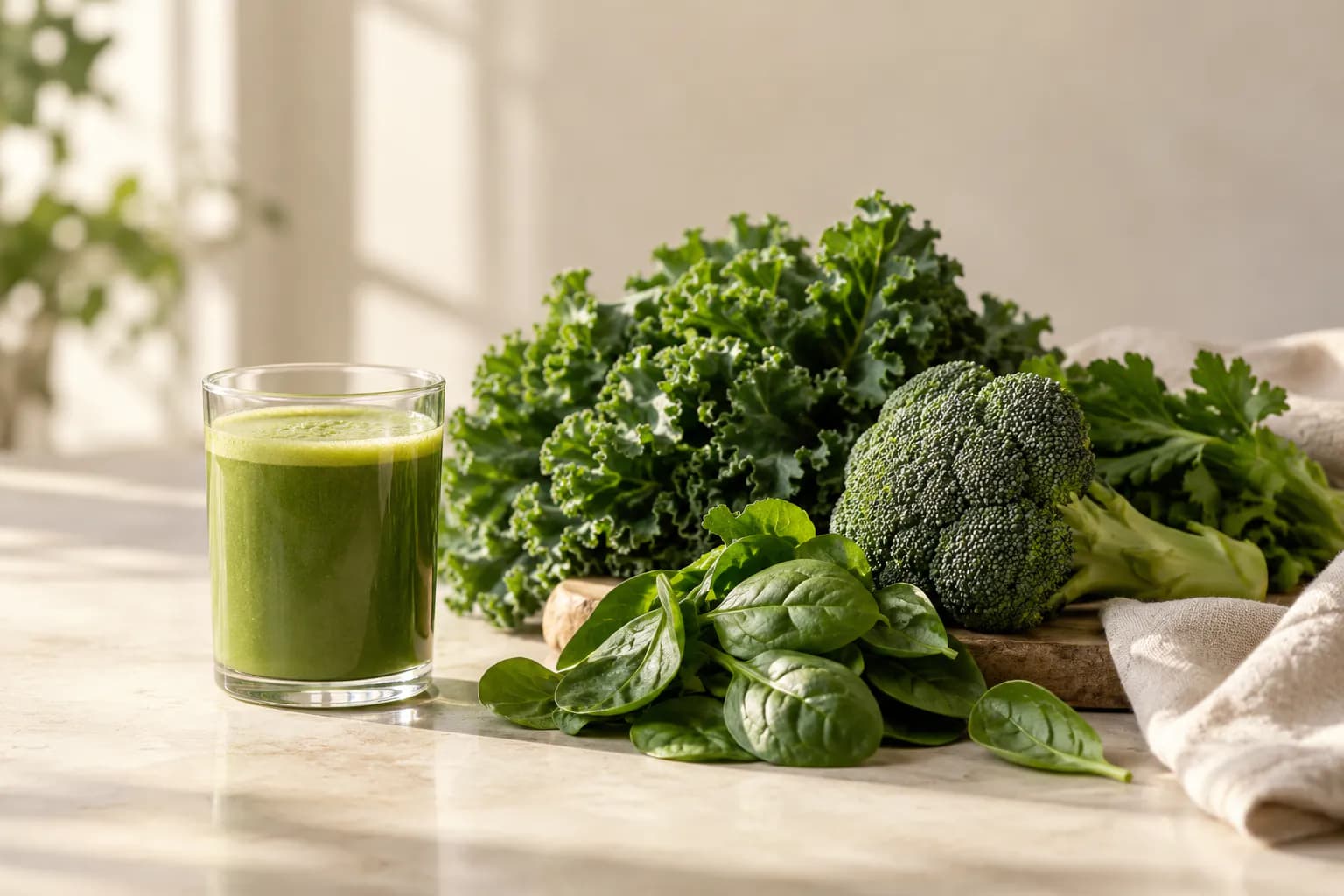
Greens powders promise a garden in a scoop, but the reality is more modest: the research is thin, the recent trials are small and often company-linked, and a scoop of powder is not a serving of vegetables. This guide covers what's actually in these products, what the studies show and don't show, which label and testing details matter, how the cost compares with frozen vegetables, and who might reasonably use one.
Why people buy them: the vegetable gap is real
The appeal makes sense. In 2019, only 10.0% of US adults ate the recommended amount of vegetables, and only 12.3% met the fruit recommendation. At the time, federal guidelines advised adults to eat 2 to 3 cup-equivalents of vegetables a day [1].
The evidence for closing that gap with actual produce is strong. In a large meta-analysis of prospective studies, each additional 200 grams a day of fruits and vegetables was associated with an 8% lower risk of cardiovascular disease and a 10% lower risk of death from any cause. Green leafy and cruciferous vegetables were among the types linked to lower cardiovascular risk and mortality [2]. In a combined analysis of more than 1.8 million people, about five servings a day, two of fruit and three of vegetables, was associated with the lowest mortality. Fruit juice, notably, was not associated with lower mortality [3]. These are observational studies, so they show associations rather than proof. Still, the findings are consistent across many cohorts, and both research teams concluded that they support recommendations to eat more fruits and vegetables [2][3].
The key question is whether a powder made from produce delivers the same benefits. So far, the evidence says we don't know.
What's actually in a greens powder
There is no standard recipe or legal definition. Labels typically draw from a familiar set of ingredient categories:
| Ingredient type | Common examples | What to check |
|---|---|---|
| Dried leafy greens and grasses | Spinach, kale, wheatgrass, barley grass, moringa | Whether amounts are disclosed or hidden in a blend |
| Algae | Spirulina, chlorella | Contaminant testing, since algae can accumulate environmental contaminants [4] |
| Fruit and vegetable juice powders | Berry, beet, citrus | Studies of these concentrates show rises in blood vitamin levels [5] |
| Fiber and prebiotics | Inulin, apple or citrus fiber | Grams of fiber per scoop, compared with the 28 g Daily Value [6] |
| Probiotics | Lactobacillus and Bifidobacterium species | Strain names, since research on one strain may not apply to another [7] |
| Herbs, mushrooms, enzymes | "Adaptogens," mushroom extracts | Doses, and possible medication interactions |
| Added vitamins and minerals | Vitamin C, B vitamins, zinc | %DV, and overlap with any multivitamin you take [8] |
Moringa leaf powder, for example, is used both in "super greens" powders and in capsules [9]. Some products also add sweeteners and flavorings, so check the sugar line and the other ingredients.
What the research on greens powders actually shows
The most consistent finding: higher vitamin levels in the blood
A useful summary of the older research is a 2011 systematic review of commercially available mixed fruit and vegetable concentrates, which covered 22 reports. Overall, daily use raised blood levels of beta-carotene, vitamins C and E, and folate. Some studies also reported lower homocysteine and lower markers of oxidative damage. But the studies varied widely in design, populations and measurements, and the authors called for larger randomized, placebo-controlled trials [5].
Recent product trials: small, short and often industry-linked
- A multi-ingredient greens powder (2024). Thirty healthy adults took the product or a placebo for four weeks. The product increased two probiotic bacterial species that "likely stem from the probiotics species that exist in the product." It did not significantly improve digestive symptoms (the reported trend had p = 0.058), and it didn't change clinical safety markers. Two authors were employees of the manufacturer [10].
- A fruit, vegetable and berry juice powder in capsules (2026). In an open-label trial of 34 older adults, six months of use was well tolerated. After statistical adjustment, homocysteine and diastolic blood pressure remained more favorable than in the control group, while other differences faded. The authors describe the results as "hypothesis-generating rather than confirmatory" [11].
Neither product trial measured outcomes such as heart attacks, strokes, cancer or survival. That is the gap between "raises vitamin C in the blood" and "does what vegetables do."
Why food benefits don't automatically transfer to powders
Nutrition science has tested the "put the good stuff in a pill" idea before. After reviewing the trials, the US Preventive Services Task Force recommends against beta-carotene and vitamin E supplements for preventing cardiovascular disease or cancer, and says the evidence is insufficient to recommend multivitamins for that purpose [12]. The FTC uses almost exactly this scenario as a textbook example of an unsubstantiated supplement claim: foods rich in a nutrient are linked with a benefit, but the effect "may be attributable to other food components," so the evidence doesn't support claims for a supplement containing that nutrient [7].
Bottom line: Greens powders can raise blood levels of some vitamins. There's no good evidence that they deliver the health outcomes linked to eating vegetables.
Claims to treat with skepticism
- "Detox" and "cleanse." The NIH's National Center for Complementary and Integrative Health points to a review that found no compelling research supporting "detox" diets for weight management or for eliminating toxins from the body [13].
- "Equivalent to X servings of vegetables." There's no standard way to make that conversion. Whole vegetables bring fiber, water and bulk as well as nutrients. Check the fiber line on the panel against the 28 g Daily Value [6].
- Disease or "immune-boosting" promises. Supplements can't legally claim to treat or prevent disease, and structure/function claims aren't FDA-reviewed (see our guide to reading supplement labels).
Proprietary blends: the transparency problem
Under FDA labeling rules, a proprietary blend only has to disclose the total weight of its ingredients that lack a Daily Value, listed in descending order by weight. Individual amounts can stay hidden [14]. For a greens powder, that means a label can name a long list of greens, algae, mushrooms and probiotics without telling you how much of any one of them is present. Because ingredients are listed from heaviest to lightest, an ingredient in the tenth position of a blend can make up no more than a tenth of the blend's weight, and possibly far less.
Pro tip: Favor products that list the amount of each ingredient. If you care about a specific component, such as spirulina or a probiotic strain, a disclosed dose is the only way to compare it with research.
Contamination: microbes and heavy metals
Microbes are not a theoretical risk
From August 2025 to June 2026, a multistate Salmonella outbreak linked to dietary supplements made with moringa leaf powder imported from India sickened 131 people in 38 states, and 36 were hospitalized. Of 84 ill people interviewed, 74 reported eating a product containing moringa leaf powder, and 63 of them reported only a "super greens" supplement powder. The recalled products were sold mainly online, and the FDA increased its screening of imported moringa powder [9].
Safety note: Young children, older adults and people with weakened immune systems are more likely to develop severe Salmonella infections [9]. If that describes you or your household, choose products with documented microbiological testing, or skip powders altogether.
Heavy metals: ask for numbers, not adjectives
Plant ingredients can carry environmental contaminants, and algae in particular can accumulate them [4]. The FDA says no safe level of lead exposure has been identified. Its interim reference levels for lead from all foods combined are 2.2 micrograms a day for children and 8.8 micrograms a day for women of childbearing age [15]. A daily powder that uses up a meaningful share of that budget is a poor trade. Algae deserve particular attention. In a 2025 analysis of 52 spirulina and chlorella supplements, all met EU limits for toxic metals, but pharmaceutical residues were detected, and organic products were no cleaner than conventional ones [4].
What to look for:
- Independent certification that covers contaminants. NSF's contents certification, for example, includes testing for heavy metals and microbiological contamination [16]. Verify the product in the certifier's database (see our guide to third-party testing).
- A lot-specific certificate of analysis that reports lead, cadmium, arsenic and mercury, ideally per serving, along with microbial tests. Words like "clean" or "pure" mean nothing without numbers.
Cost: greens powder vs. frozen vegetables
USDA's Economic Research Service tracks what produce actually costs per cup-equivalent, the unit used in federal intake guidance. In 2023, frozen versions of common greens cost about $0.92 to $1.19 per cup-equivalent, and a frozen mixed-vegetable blend about $0.76 [17]:
| Option | Approximate cost per serving | What you get |
|---|---|---|
| Frozen kale, 1 cup-equivalent | $0.92 [17] | A leafy green with whole-food fiber, water and nutrients |
| Frozen broccoli, 1 cup-equivalent | $1.00 [17] | A cruciferous vegetable, a group linked with lower cardiovascular risk and mortality [2] |
| Frozen spinach, 1 cup-equivalent | $1.19 [17] | Leafy green, easy to add to eggs, soups and smoothies |
| Frozen broccoli, cauliflower and carrot mix, 1 cup-equivalent | $0.76 [17] | Variety at a low cost |
| Greens powder, $45 tub with 30 scoops (illustrative) | $1.50 per scoop | Concentrated plant powders, variable doses |
| Greens powder, $80 tub with 30 scoops (illustrative) | $2.67 per scoop | Varies. May include added vitamins or probiotics |
To compare any product, divide the price by the number of scoops. Keep in mind that a scoop isn't equivalent to a cup-equivalent of vegetables. If budget matters, frozen vegetables deliver the food the evidence supports, at a known and modest cost.
Who might benefit, and who should be careful
Might reasonably use one: adults whose vegetable intake is genuinely low, who will take it consistently alongside efforts to eat more produce, or who want a convenient backup while traveling. For them, the realistic benefit is a modest boost in some vitamins and plant compounds [5]. Multivitamins, by comparison, are designed to supply set amounts of nutrients, but ODS notes that they can't take the place of a varied diet either [8].
Check with a clinician or pharmacist first if you:
- Take warfarin. Vitamin K interacts with warfarin, and people taking it need a consistent vitamin K intake from food and supplements, because sudden changes can strengthen or weaken the drug's effect. Green leafy vegetables are the main dietary source of vitamin K [18], so a daily greens powder is exactly the kind of change to discuss with your prescriber first [8][18].
- Have a thyroid condition. Seaweed, such as kelp, is among the richest sources of iodine, and too much iodine can itself cause thyroid problems [19].
- Are prone to kidney stones. NIH lists leafy green vegetables among high-oxalate foods, and people susceptible to kidney stones are advised to limit those foods [13].
- Take other supplements. Combining several products and fortified foods can push some nutrients above their upper limits [8].
- Are pregnant or breastfeeding, or are buying for a child. Herbal and "adaptogen" ingredients may not have been studied in these groups, so ask first.
How to choose a quality greens powder
- Transparent label: individual ingredient amounts instead of a proprietary blend [14].
- Verified testing: an independent certification that covers heavy metals and microbes, confirmed in the certifier's database [16].
- A lot-specific COA with contaminant results you can read.
- Sensible added nutrients: no nutrient near its upper limit, especially if you also take a multivitamin [8].
- Named probiotic strains and counts, if probiotics are part of the pitch [7].
- No "detox" or disease claims [13].
- Honest math: cost per scoop compared with frozen vegetables [17].
The bottom line
Greens powders aren't useless, and they aren't vegetables. The best evidence shows they can raise blood levels of some vitamins. The health outcomes linked to eating produce, including lower cardiovascular and all-cause mortality, have not been shown for any powder. Products vary widely in transparency and quality, and contamination with microbes or heavy metals is a documented risk. If you enjoy one and can afford it, choose a fully disclosed, independently tested product and use it alongside real vegetables. If you're choosing where to spend your money, a bag of frozen broccoli is the better-supported buy.
This article is for general information and isn’t medical advice. Supplements can interact with medications and conditions — talk to a qualified healthcare professional before starting one. Medical disclaimer.
Frequently asked questions
Can a greens powder replace vegetables?
Are greens powders safe?
Is there good evidence that greens powders work?
Are organic greens powders cleaner?
Is a greens powder or a multivitamin better for filling nutrient gaps?
References
- [1]Adults Meeting Fruit and Vegetable Intake Recommendations - United States, 2019Lee SH, et al. MMWR Morbidity and Mortality Weekly Report (2022)
- [2]Fruit and vegetable intake and the risk of cardiovascular disease, total cancer and all-cause mortality: a systematic review and dose-response meta-analysis of prospective studiesAune D, et al. International Journal of Epidemiology (2017)
- [3]Fruit and Vegetable Intake and Mortality: Results From 2 Prospective Cohort Studies of US Men and Women and a Meta-Analysis of 26 Cohort StudiesWang DD, et al. Circulation (2021)
- [4]Spirulina and Chlorella Dietary Supplements: Are They a Source Solely of Valuable Nutrients?Sochacka M, et al. International Journal of Molecular Sciences (2025)
- [5]Health effects of mixed fruit and vegetable concentrates: a systematic review of the clinical interventionsEsfahani A, et al. Journal of the American College of Nutrition (2011)
- [6]Daily Value on the Nutrition and Supplement Facts LabelsU.S. Food and Drug Administration
- [7]Health Products Compliance GuidanceFederal Trade Commission (December 2022)
- [8]Multivitamin/mineral Supplements: Fact Sheet for Health ProfessionalsNIH Office of Dietary Supplements (updated July 2024)
- [9]Outbreak Investigation of Salmonella: Moringa Leaf Powder (January 2026)U.S. Food and Drug Administration (final update July 22, 2026)
- [10]The effects of AG1® supplementation on the gut microbiome of healthy adults: a randomized, double-blind, placebo-controlled clinical trialLa Monica MB, et al. Journal of the International Society of Sports Nutrition (2024)
- [11]Effects of a Commercial Fruit, Vegetable and Berry Juice Powder Concentrate on Metabolic Safety and Cardiovascular Health in Older Adults: 6-Month Results of a Randomized Controlled TrialZiegler T, et al. Nutrients (2026)
- [12]Vitamin, Mineral, and Multivitamin Supplementation to Prevent Cardiovascular Disease and Cancer: US Preventive Services Task Force Recommendation StatementUS Preventive Services Task Force. JAMA (2022)
- [13]Detoxes and Cleanses: What You Need To KnowNational Center for Complementary and Integrative Health, NIH (updated March 2025)
- [14]21 CFR § 101.36 - Nutrition labeling of dietary supplementsCode of Federal Regulations (via Cornell Legal Information Institute)
- [15]Lead in Food and FoodwaresU.S. Food and Drug Administration
- [16]How to Get Certified: What Does It Take to Be Certified for SportNSF Certified for Sport
- [17]Fruit and Vegetable Prices (2023 average retail prices per cup equivalent)USDA Economic Research Service (updated December 2025)
- [18]Vitamin K: Fact Sheet for Health ProfessionalsNIH Office of Dietary Supplements
- [19]Iodine: Fact Sheet for Health ProfessionalsNIH Office of Dietary Supplements