On this page
- Vitamin D and K2 in brief
- Decoding the label: IU vs. mcg
- What your blood test means: 25(OH)D cutoffs
- Who should consider supplementing?
- How much vitamin D3 to take
- Timing and absorption: take it with a meal that contains fat
- Does adding K2 help? What the MK-7 research shows
- Safety: warfarin and other interactions
- How to choose a quality D3 + K2 supplement
- The bottom line
Key takeaways
- 1 mcg of vitamin D equals 40 IU. The adult RDA is 600–800 IU (15–20 mcg), and the upper limit is 4,000 IU (100 mcg) a day.
- The 2024 Endocrine Society guideline suggests extra vitamin D for ages 1–18, adults 75 and older, pregnancy and high-risk prediabetes, but not for healthy adults under 75, and advises against routine blood testing.
- Take vitamin D with a meal that contains fat. D3 raises blood levels more reliably than D2, and daily doses are preferred over large intermittent ones.
- K2 (MK-7) reliably improves vitamin K–dependent biomarkers, but trials show mixed bone results and no slowing of heart valve or artery calcification.
- Anyone taking warfarin or a similar anticoagulant should not start K2 without their prescriber, because as little as 10–45 mcg of MK-7 can shift clotting tests.
Vitamin K supplements are frequently combined with vitamin D [2], and the pairing is often promoted as a way to steer calcium into your bones rather than your arteries. The truth is more nuanced. Vitamin D is well understood and genuinely useful for some groups, while K2's benefits are plausible but not proven. This guide covers how to read the doses, what your blood test means, who benefits from supplementing, how to time it, and the one interaction you can't ignore.
Vitamin D and K2 in brief
Vitamin D is a fat-soluble vitamin your skin makes from sunlight. It is also found naturally in a few foods and added to others, and it helps your body absorb calcium [1]. Vitamin K is a family of fat-soluble compounds: K1 (phylloquinone) from leafy greens, and K2 (menaquinones, labeled MK-4 through MK-13), which come mainly from bacteria and appear in animal and fermented foods. Natto, a Japanese fermented soybean dish, is especially rich in them [2]. Vitamin K activates proteins that need it to work, including osteocalcin in bone and matrix Gla protein (MGP) in blood vessel walls [2].
The case for pairing them is mechanistic. Vitamin D increases production of vitamin K–dependent proteins, which then need vitamin K to be activated [3]. A narrative review argues that the two may work better together [3], but as you'll see below, clinical trials haven't confirmed that K2 improves hard outcomes.
Decoding the label: IU vs. mcg
Vitamin D is listed in both micrograms and International Units, and 1 mcg equals 40 IU [1]. The RDA assumes minimal sun exposure: 600 IU (15 mcg) a day for ages 1–70 and 800 IU (20 mcg) after 70. The Tolerable Upper Intake Level for everyone aged 9 and older is 4,000 IU (100 mcg) [1].
| Label amount | Micrograms | What it corresponds to |
|---|---|---|
| 400 IU | 10 mcg | Adequate intake for infants [1] |
| 600 IU | 15 mcg | RDA, ages 1–70 [1] |
| 800 IU | 20 mcg | RDA, over age 70 [1] |
| 1,000 IU | 25 mcg | Dose paired with K2 in the AVADEC trial [15] |
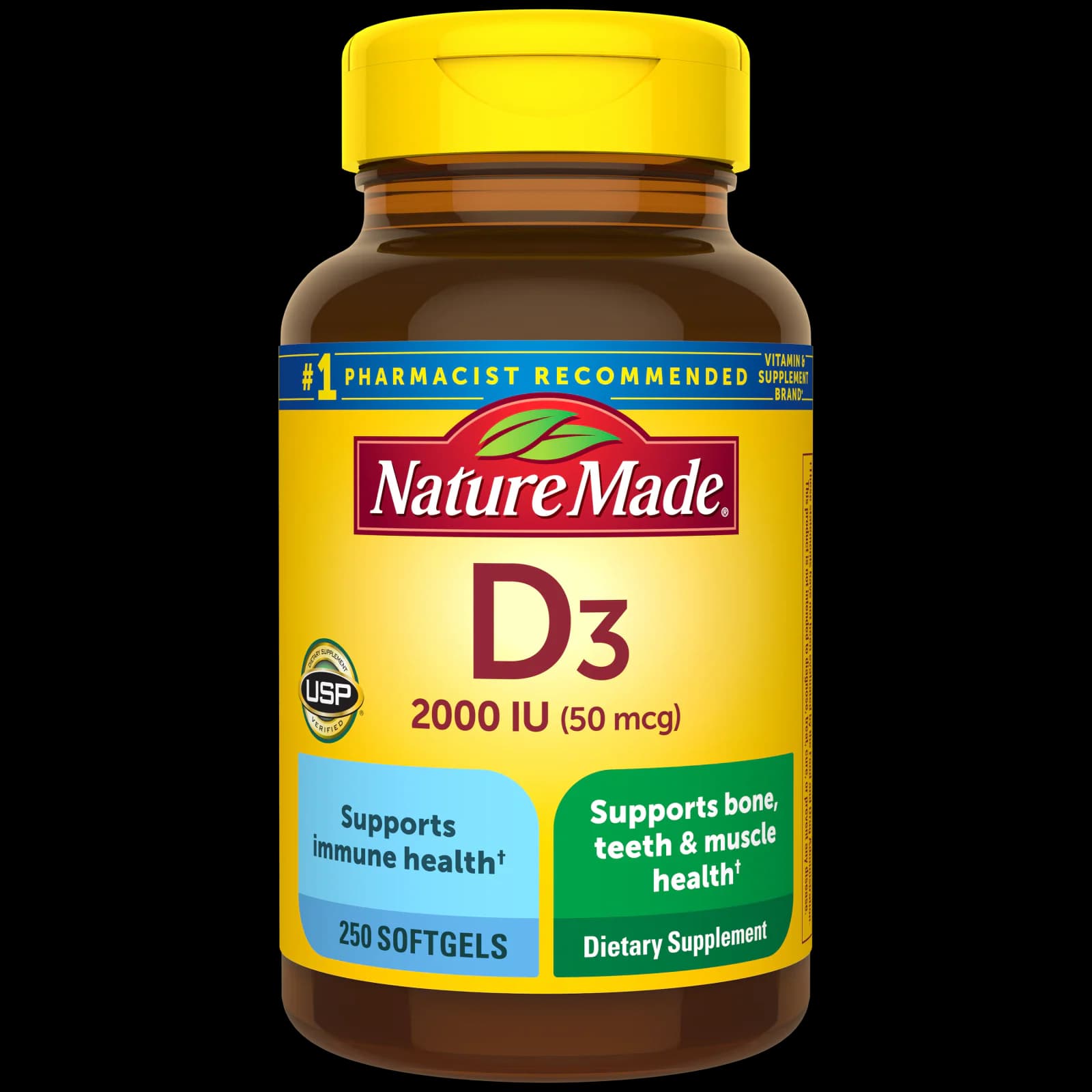
| 2,000 IU | 50 mcg | Daily dose tested in the VITAL trial [6] |
| 4,000 IU | 100 mcg | Upper limit, ages 9 and older [1] |
| 10,000 IU | 250 mcg | Well above the upper limit; lowered bone density vs. 400 IU in a 3-year trial [8] |
Vitamin K has no IU. It's listed in micrograms, with an adequate intake of 120 mcg a day for men and 90 mcg for women. No upper limit has been set, because no adverse effects from vitamin K in food or supplements have been reported [2].
What your blood test means: 25(OH)D cutoffs
Your vitamin D status is measured as serum 25-hydroxyvitamin D, or 25(OH)D, which reflects vitamin D from sun, food and supplements. It has a half-life of about 15 days, so levels take weeks to reflect a change in dose [1]. Results are reported in ng/mL or nmol/L (1 ng/mL = 2.5 nmol/L) [1].
The Food and Nutrition Board at the National Academies interprets levels like this [1]:
- Below 12 ng/mL (30 nmol/L): at risk of deficiency
- 12–20 ng/mL (30–50 nmol/L): potentially inadequate for some people
- 20 ng/mL (50 nmol/L) or higher: sufficient for most people
- Above 50 ng/mL (125 nmol/L): potential for adverse effects
In US survey data, 5% of people were at risk of deficiency and 18% at risk of inadequacy [1]. Keep two caveats in mind. Lab assays vary, so the same blood sample can read falsely low or high depending on the method [1]. And experts disagree on the ideal level: the Endocrine Society's 2024 guideline found no clear evidence defining an optimal target for disease prevention [4].
Should you get tested?
For most healthy people, probably not. The US Preventive Services Task Force concluded that the evidence is insufficient to recommend screening adults without symptoms [5]. The Endocrine Society suggests against routine 25(OH)D testing in the general population, including people with obesity or darker skin [4]. Its advice doesn't apply to people with established reasons for testing, so ask your clinician if you have a condition that affects fat absorption or bone health, or take medicines that affect vitamin D [1][4].
Who should consider supplementing?
The 2024 Endocrine Society guideline suggests "empiric" vitamin D (above the RDA, without testing) for four groups: children and teens aged 1–18, adults 75 and older, pregnant people, and adults with high-risk prediabetes [4]. For healthy adults under 75, it suggests against taking more than the RDA to prevent disease [4].
Some groups are more likely to fall short and should talk with their clinician about their intake [1]:
- Breastfed infants. Human milk alone doesn't usually meet an infant's needs.
- Older adults. The skin makes less vitamin D with age, and many older adults spend more time indoors.
- People with limited sun exposure, including those who are homebound or cover most of their skin.
- People with darker skin, because more melanin reduces vitamin D production in the skin.
- People with fat-malabsorption conditions, such as Crohn's disease, celiac disease, cystic fibrosis or some liver diseases.
- People with obesity or who have had gastric bypass surgery.
What about everyone else? In the VITAL trial, 25,871 US adults (men 50 and older, women 55 and older) took 2,000 IU of D3 a day or a placebo for a median of 5.3 years. Vitamin D did not lower rates of invasive cancer or major cardiovascular events [6], and it did not reduce fractures in people who weren't selected for deficiency or osteoporosis [7]. It also caused no excess cases of high blood calcium [6].
How much vitamin D3 to take
- Meet, don't massively exceed, the RDA. For most adults that's 600–800 IU a day from all sources, including fortified foods, which supply most of the vitamin D in American diets [1]. Higher doses belong in a treatment plan from a clinician.
- Daily beats big and infrequent. For people over 50 who need vitamin D, the Endocrine Society suggests daily dosing rather than intermittent high doses [4]. In older women, a single annual dose of 500,000 IU actually increased falls (rate ratio 1.15) and fractures (1.26) compared with placebo [9].
- More isn't better for bones. In a three-year trial of 311 healthy adults aged 55–70, those taking 4,000 or 10,000 IU a day had slightly lower bone density at the wrist than those taking 400 IU, with no gain in bone strength [8].
- Respect the upper limit. Toxicity causes high blood calcium, which can lead to nausea, weakness, kidney stones and, in extreme cases, kidney failure. It almost always results from excessive supplement use. The Food and Nutrition Board noted that toxicity symptoms are unlikely below 10,000 IU a day, but that adverse effects may occur over time even below the upper limit, and it recommended avoiding 25(OH)D levels above about 50–60 ng/mL [1].
Pro tip: Before buying a standalone vitamin D, add up what you already get. Average US intake from food and drinks is only about 190 IU a day, a cup of fortified milk or plant milk provides about 120 IU [1], and your multivitamin may add more. Check its label.
Timing and absorption: take it with a meal that contains fat
The concurrent presence of fat in the gut enhances vitamin D absorption, although some is absorbed without it [1]. In a controlled study of 50 older adults, a single dose of D3 taken with a breakfast containing fat produced a 32% higher peak blood level of vitamin D3 than the same dose taken with a fat-free breakfast [11]. Vitamin K is also fat-soluble [2], so take your D3 + K2 with a meal. Your largest meal of the day is a practical choice.
We found no good trial evidence that morning versus evening dosing matters, so choose the time you'll remember consistently.
D3 or D2? Both raise blood levels, but most evidence indicates that D3 raises 25(OH)D more and keeps it higher for longer [1]. In a meta-analysis, D3's advantage was clearest with large intermittent doses and less apparent with daily dosing [10]. D3 is traditionally made from lanolin in sheep's wool, and an animal-free version sourced from lichen is also available [1].
Does adding K2 help? What the MK-7 research shows
Supplements use two main forms of K2, MK-4 and MK-7, and MK-7 is the form found in natto [2][12]. MK-7 is well absorbed and has a much longer half-life than K1, and with daily use its blood levels rise to 7–8 times higher than those of K1 [12]. K2 reliably makes vitamin K–dependent proteins more active [14][16]. Whether that improves outcomes is another question.
Bone. In a three-year trial of 244 healthy postmenopausal women, 180 mcg of MK-7 a day slowed age-related loss of bone mineral density at the lumbar spine and femoral neck, but not at the total hip, and reduced loss of vertebral height [13]. In another trial, 334 early postmenopausal women took 360 mcg a day for one year. MK-7 improved osteocalcin activation but did not change bone loss [14].
Arteries and heart valves. In the AVADEC trial, 365 older men with aortic valve calcification took 720 mcg of MK-7 plus 1,000 IU of vitamin D, or a placebo, for two years. The combination didn't slow valve calcification or artery calcification, even though a marker of vitamin K status improved [15]. A systematic review of nine trials concluded that vitamin K clearly improves activation of MGP but doesn't consistently prevent calcification, atherosclerosis or arterial stiffening [16].
Bottom line on K2: It's a reasonable add-on for people who want it, but the claim that vitamin D is unsafe without K2 isn't supported. The large VITAL trial, which used vitamin D without K2, found no excess of high blood calcium or other adverse events [6].
Safety: warfarin and other interactions
Vitamin K antagonists (warfarin and similar drugs). This is the most important interaction. Vitamin K directly counteracts these anticoagulants, and people taking them need a consistent vitamin K intake [2]. In healthy volunteers on a vitamin K antagonist, MK-7 doses of 10 and 20 mcg a day caused a clinically relevant drop in INR in at least 40% and 60% of participants, and 45 mcg a day lowered average INR by about 40%. The authors concluded that MK-7 supplements should be avoided during vitamin K antagonist therapy [17]. An earlier study warned that 50 mcg a day or more of MK-7 may interfere with anticoagulants in a clinically relevant way [12].
Vitamin D interactions [1]:
- Orlistat can reduce vitamin D absorption.
- Statins and vitamin D may interact. High vitamin D intakes might reduce the potency of atorvastatin, lovastatin and simvastatin.
- Corticosteroids can impair vitamin D metabolism.
- Thiazide diuretics combined with vitamin D can raise blood calcium, especially in older adults and people with reduced kidney function or hyperparathyroidism.
Calcium stacking. In a large trial of postmenopausal women, 1,000 mg of calcium plus 400 IU of vitamin D a day raised kidney stone risk by 17% over seven years [1]. If your D3 + K2 product also contains calcium, count it toward your total.
Safety note: If you take an anticoagulant, have kidney disease, or have a history of high calcium or kidney stones, talk with your healthcare professional before starting vitamin D3 + K2.
How to choose a quality D3 + K2 supplement
- Check both doses in micrograms. Look for vitamin D3 (cholecalciferol) at a dose that, with your diet, lands near the RDA. For many adults, a 400–800 IU supplement does that. Higher amounts, up to the 4,000 IU upper limit, should have a specific reason. K2 should be listed by form, such as menaquinone-7 (MK-7), with its amount.
- Prefer third-party verified products. Label accuracy is a real issue. When researchers tested over-the-counter and compounded vitamin D3 pills, potency ranged from 9% to 146% of the labeled dose. The USP-verified manufacturer was generally more accurate and less variable [18]. The USP Verified Mark indicates that ingredients match the label, harmful contaminants were not found at specified levels, the product breaks down properly, and good manufacturing practices were followed [19].
- Vegan? Look for lichen-derived D3 or D2 [1].
- Watch the extras. Calcium, magnesium and "bone blends" change the math on your total intake.
- Red flags: 10,000 IU "immune" mega-doses sold for daily use, and claims that the product prevents heart disease, cancer or osteoporosis.
The bottom line
Vitamin D is worth supplementing if you're in a higher-risk or guideline-recommended group, and taking it daily with a meal that contains fat, at or near the RDA, covers most adults. More isn't better, and routine testing isn't necessary for most healthy people. K2 is a biologically sensible partner with mixed and mostly biomarker-level evidence. It's fine to include if you like, but skip it entirely if you take warfarin or a similar anticoagulant, unless your prescriber is on board.
This article is for general information and isn’t medical advice. Supplements can interact with medications and conditions — talk to a qualified healthcare professional before starting one. Medical disclaimer.
Frequently asked questions
What's the best time of day to take vitamin D3 and K2?
How much vitamin D3 should I take daily?
Do I need K2 if I take vitamin D?
Is 5,000 IU of vitamin D a day safe?
Can I take vitamin D3 + K2 if I'm on blood thinners?
References
- [1]Vitamin D: Fact Sheet for Health ProfessionalsNIH Office of Dietary Supplements (updated June 2025)
- [2]Vitamin K: Fact Sheet for Health ProfessionalsNIH Office of Dietary Supplements (updated March 2021)
- [3]The Synergistic Interplay between Vitamins D and K for Bone and Cardiovascular Health: A Narrative ReviewInternational Journal of Endocrinology (2017)
- [4]Vitamin D for the Prevention of Disease: An Endocrine Society Clinical Practice GuidelineThe Journal of Clinical Endocrinology & Metabolism (2024)
- [5]Screening for Vitamin D Deficiency in Adults: US Preventive Services Task Force Recommendation StatementJAMA (2021)
- [6]Vitamin D Supplements and Prevention of Cancer and Cardiovascular Disease (VITAL)The New England Journal of Medicine (2019)
- [7]Supplemental Vitamin D and Incident Fractures in Midlife and Older AdultsThe New England Journal of Medicine (2022)
- [8]Effect of High-Dose Vitamin D Supplementation on Volumetric Bone Density and Bone Strength: A Randomized Clinical TrialJAMA (2019)
- [9]Annual high-dose oral vitamin D and falls and fractures in older women: a randomized controlled trialJAMA (2010)
- [10]Comparison of vitamin D2 and vitamin D3 supplementation in raising serum 25-hydroxyvitamin D status: a systematic review and meta-analysisThe American Journal of Clinical Nutrition (2012)
- [11]Dietary fat increases vitamin D-3 absorptionJournal of the Academy of Nutrition and Dietetics (2015)
- [12]Vitamin K-containing dietary supplements: comparison of synthetic vitamin K1 and natto-derived menaquinone-7Blood (2007)
- [13]Three-year low-dose menaquinone-7 supplementation helps decrease bone loss in healthy postmenopausal womenOsteoporosis International (2013)
- [14]Vitamin K2 supplementation does not influence bone loss in early menopausal women: a randomised double-blind placebo-controlled trialOsteoporosis International (2010)
- [15]Vitamin K2 and D in Patients With Aortic Valve Calcification: A Randomized Double-Blinded Clinical Trial (AVADEC)Circulation (2022)
- [16]Vitamin K Supplementation for the Prevention of Cardiovascular Disease: Where Is the Evidence? A Systematic Review of Controlled TrialsNutrients (2020)
- [17]Effect of low-dose supplements of menaquinone-7 (vitamin K2) on the stability of oral anticoagulant treatment: dose-response relationship in healthy volunteersJournal of Thrombosis and Haemostasis (2013)
- [18]Over-the-counter and compounded vitamin D: is potency what we expect?JAMA Internal Medicine (2013)
- [19]USP Verified MarkU.S. Pharmacopeia